
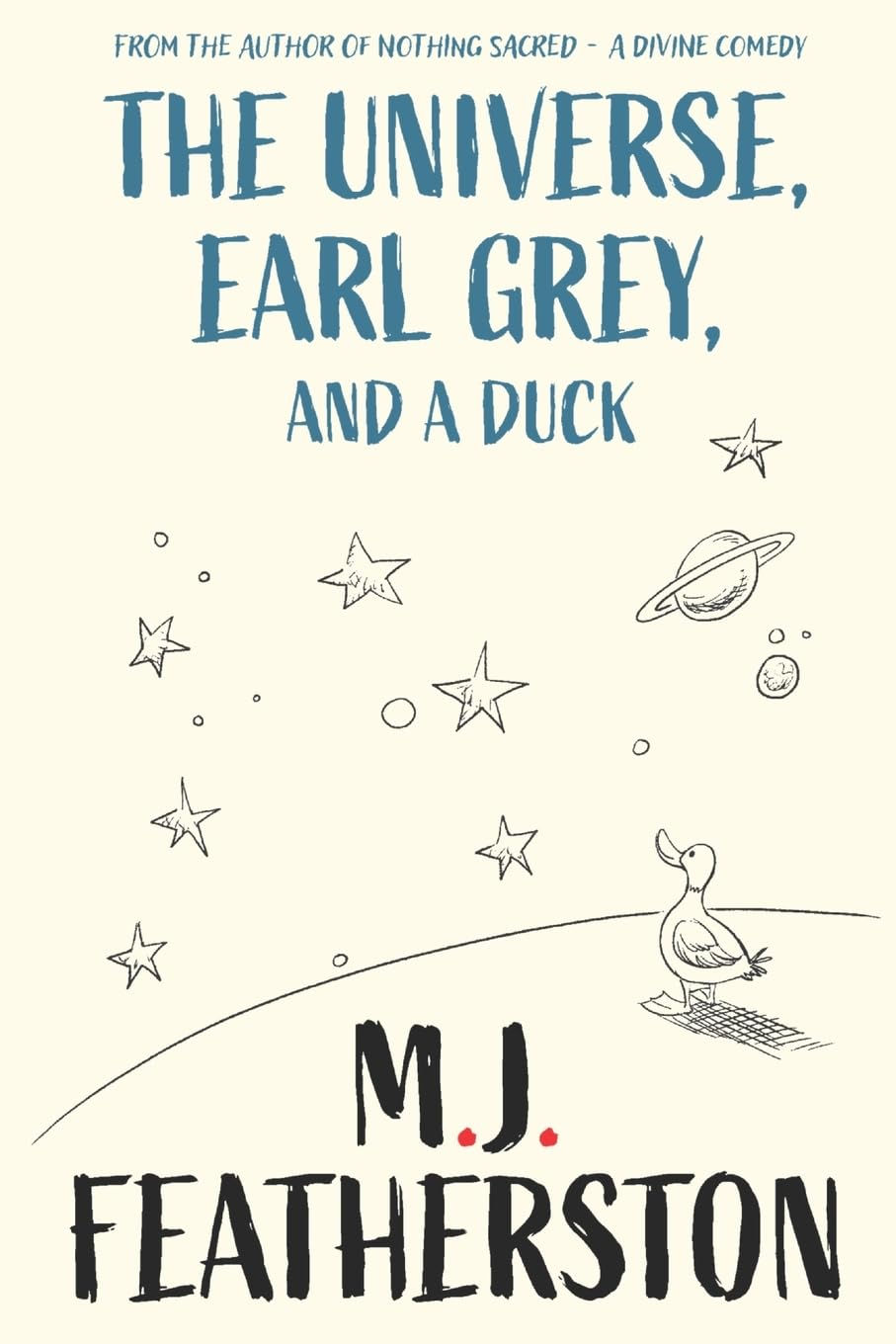
Book Review: The Universe, Earl Grey, And A Duck by M.J. Featherston
.jpg/v1/fill/w_320,h_320/file.jpg)
Updated: Jun 13
Rating: ★★★★½☆

Every now and then, a completely unassuming book slips into your hands and surprises you with how much soul it carries.
The Universe, Earl Grey, and a Duck is exactly that kind of discovery.
At first glance, it appears almost whimsical—a curious title, a peculiar premise, and a sense of light absurdity that suggests a charming diversion rather than a meaningful reading experience. Yet beneath that playful exterior lies a
thoughtful and quietly philosophical novel that lingers long after its final page.
What impressed me most was Featherston's restraint.
Many books that tackle questions of existence, purpose, and identity often arrive armed with answers. They lecture. They persuade. They bend over backwards trying to convince the reader of their own profundity.
This book does none of that.
Instead, it approaches life's biggest questions with curiosity rather than certainty. It wanders rather than argues. It explores rather than explains. And in doing so, it becomes far wiser than many novels that take themselves far more seriously.
Featherston writes with a subtle wit that never feels forced. The humour emerges naturally from the situations and conversations, often catching the reader off guard. There is an underlying absurdity to the entire novel, but it is the kind of absurdity that illuminates rather than obscures. The stranger the circumstances become, the more recognizably human the story feels.
What I appreciated most is how the narrative never abandons curiosity. It treats big questions with innocence rather than arrogance.
In that regard, it reminded me of several books I deeply admire:
The Little Prince — wonder dressed as simplicity.
Sophie's World — philosophy disguised as a story.
Holy Cow — absurdity that somehow lands on truth.
Like those novels, The Universe, Earl Grey, and a Duck understands that meaningful questions are often more valuable than definitive answers.
There is also something refreshingly humble about the novel's worldview. Rather than treating philosophy as an exercise reserved for academics or intellectuals, it presents curiosity as something universal. The questions at the heart of the story belong to everyone. Who are we? Why are we here? What gives life meaning? How do we live with uncertainty?
The book never pretends to possess definitive answers.
Instead, it invites the reader to sit comfortably with the questions.
That invitation may be its greatest achievement.
Featherston seems to understand that sometimes the best way to explore the universe is not through grand declarations, but through tea, conversation, and creatures that have no business being wise, yet somehow are.
And sometimes, that creature is a duck.
In an age where so much fiction strives to be louder, darker, bigger, or more shocking, The Universe, Earl Grey, and a Duck feels remarkably content to be small. It hums rather than shouts. It trusts its readers. It leaves space for contemplation.
This is not a book built around plot twists or dramatic revelations. It is a book built around conversations, ideas, curiosity, and quiet moments of insight. Readers seeking fast-paced action may overlook it entirely. Those willing to slow down and follow its peculiar path, however, may discover something unexpectedly meaningful.
A quietly brilliant, unusual delight.
I only wish more readers would stumble into it the way I did—by accident, and then with gratitude.
Rating: ★★★★½☆



Comments