
Book Review: Babel by R.F. Kuang
- Joana .
.jpg/v1/fill/w_320,h_320/file.jpg)
- Dec 30, 2022
- 4 min read
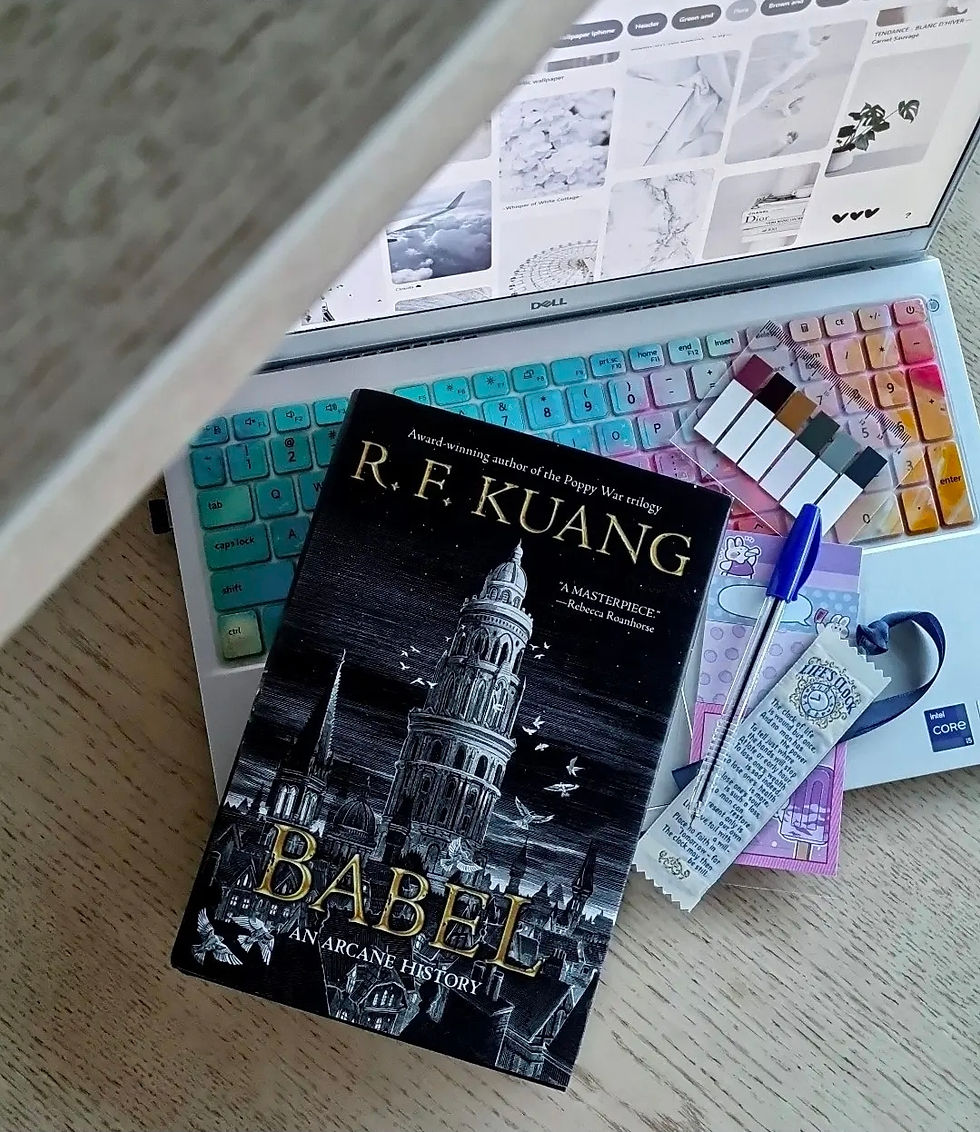
★★★★☆
"You have such a great fear of freedom, brother. It's shackling you."
Few books have left me with as many conflicting thoughts as Babel.
On the one hand, it is a remarkably ambitious novel: part fantasy, part dark academia, part historical fiction, and part political commentary. On the other, it is a book so deeply invested in its ideas that it occasionally loses sight of the story it is trying to tell.
And yet, despite its flaws, I found the experience unforgettable.
At its heart, Babel is a novel about language and power. About who gets to tell history, who benefits from knowledge, and who pays the price for progress. These are not themes I would normally gravitate toward. Colonialism, revolution, imperialism, and linguistic theory are hardly subjects I seek out when choosing my next read. Yet R.F. Kuang managed to take topics I thought would never interest me and transform them into something compelling.
The novel begins strongly with Robin Swift's journey to Oxford and his introduction to Babel, the Royal Institute of Translation. From the moment he arrives, the world feels rich, immersive, and meticulously researched. The atmosphere practically drips with dark academia: ancient institutions, secret knowledge, scholarly obsession, and the uncomfortable realization that knowledge itself can become a tool of oppression.
What surprised me most was how invested I became in the discussions surrounding translation and etymology.
Prior to reading Babel, I never gave much thought to linguistics as a field. Kuang, however, demonstrates how language is never neutral. Through translation, she explores questions of culture, ownership, identity, and empire. The result is a novel that feels both educational and thought-provoking without ever losing sight of the emotional stakes behind these discussions.
And as a self-confessed academic nerd, I must admit that I adored the footnotes.
Indexes, references, maps, diagrams, appendices—give me any excuse to dive deeper into a world, and I will happily do so. I often found myself pausing my reading to explore the footnotes, treating them almost as a secondary narrative running alongside the main story. It is a small detail, perhaps, but one that added immensely to my enjoyment of the book.
Kuang's prose is another undeniable strength. The writing is intelligent, elegant, and richly textured. In an era where many books feel rushed to publication, Babel feels carefully crafted. Whether discussing friendship, grief, loss, war, or identity, Kuang writes with confidence and clarity.
That said, no book is without flaws.
My biggest criticism stems from the same place as my admiration: Kuang's passion for her subject matter.
As a researcher myself, I recognize the temptation to include every fascinating detail uncovered during months or years of study. There were numerous moments throughout the novel where it felt as though Kuang became so invested in presenting her research that the narrative slowed to a crawl. Entire sections could have been condensed without losing their impact. In fact, I suspect the novel could have lost well over a hundred pages and emerged stronger for it.
The issue is not that the information is uninteresting. Quite the opposite. The issue is that not every fascinating detail serves the story.
Because so much time is devoted to explaining concepts and reinforcing themes, it takes a surprisingly long time for the novel's broader direction to emerge. There were moments when I found myself wondering where all of this was leading, and a few occasions when I considered setting the book aside altogether.
The characters presented a similar challenge.
Individually, Robin, Ramy, Victoire, and Letty are all distinct and thoughtfully constructed. Their backgrounds, motivations, and perspectives create fascinating tensions within the group. However, while I appreciated what Kuang was attempting, I never felt that most of their character arcs reached their full potential.
Ironically, despite spending hundreds of pages with them, I found myself struggling to truly connect with any of them. If I had to choose a standout, it would probably be Ramy, whose development felt the most complete and emotionally satisfying.
Then there is the magic system.
I admire originality, and I appreciate the challenge of creating an entirely new magical framework. Yet the silver-working system at the heart of Babel never fully clicked for me. It is certainly unique, but I often found it difficult to grasp intuitively. Perhaps the extensive linguistic explanations made it feel more theoretical than magical. Whatever the reason, it remains one of the less memorable aspects of the novel for me.
And finally, the ending.
After such a grand build-up, I expected something more impactful. The conclusion felt surprisingly restrained compared to the scale of the ideas that preceded it. Not necessarily bad, but less powerful than the journey leading up to it.
Still, for all my criticisms, I cannot deny how much I admired this book.
Babel is intelligent, ambitious, beautifully written, and unlike anything else I have read. It tackles enormous questions about language, empire, knowledge, and resistance while wrapping them in a compelling dark-academic fantasy. Even when it overexplains, even when it stumbles, and even when it frustrates, it remains fascinating.
This is not a book for everyone. Readers looking for a fast-paced fantasy adventure may find themselves overwhelmed by its density and academic digressions. But for those who enjoy immersive worlds, intellectual debates, beautiful prose, and stories unafraid to wrestle with difficult questions, Babel offers a uniquely rewarding experience.
Flawed? Absolutely.
Memorable? Without question.
Rating: 3.5–4 ★


Comments